
Stream Rules
Overview
Stream Rules are used to immediately detect threats by correlating real-time data based on predefined patterns or conditions. For example, they can detect high-risk attacks by identifying specific patterns in IPS logs or detect data exfiltration when outbound traffic volume exceeds a defined threshold.
The illustration below shows how a stream rule operates. Stream rules are applied to data that has been normalized during the ingestion phase. When creating a stream rule, be sure to use field names that have been normalized according to the log schemas.
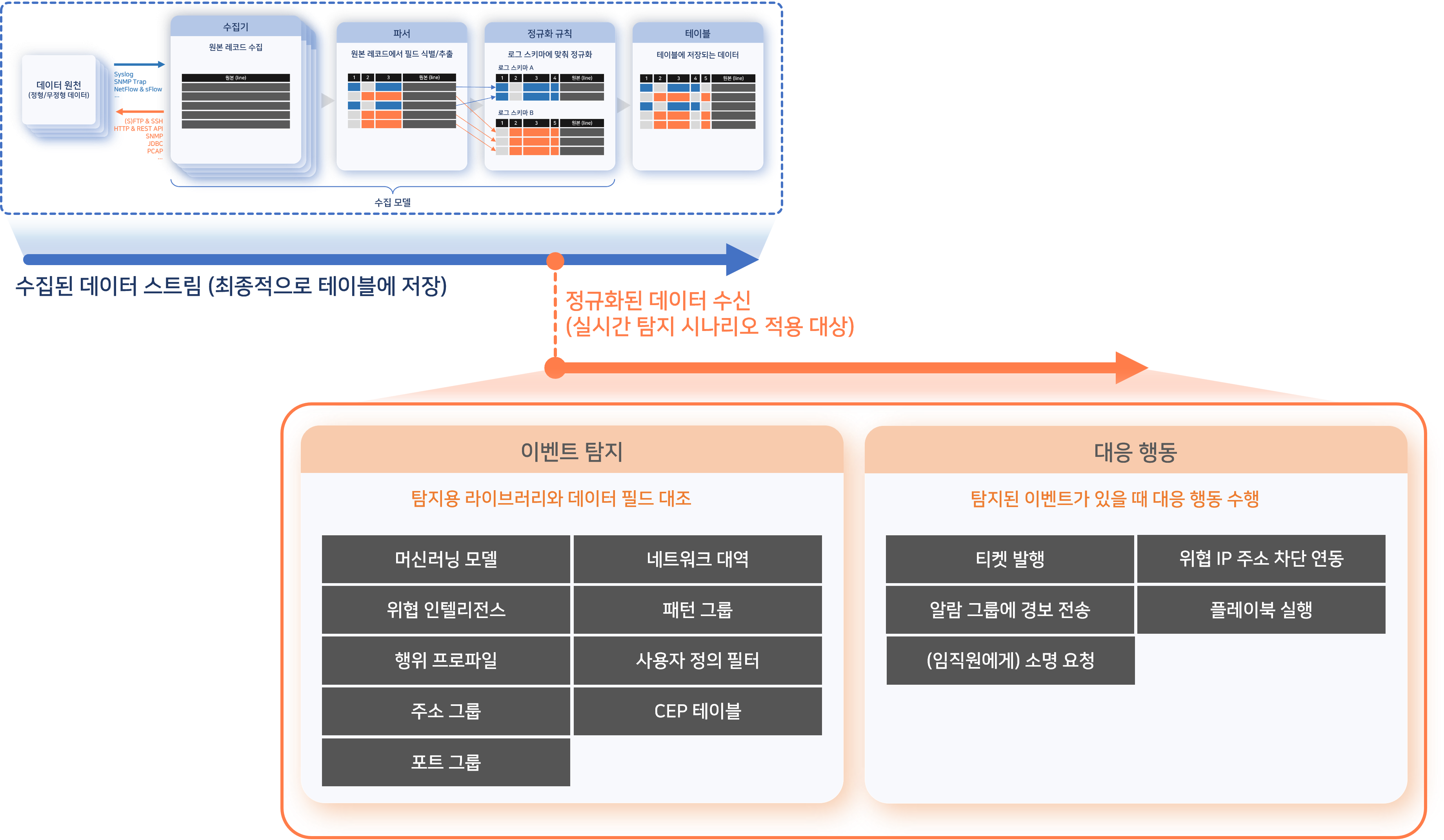
Stream rules perform the following key actions:
-
Event Detection:
- Match detection libraries against normalized field values.
-
Response Actions:
- Issue tickets and send alarms for detected events.
- Request an explanation if the actor is an employee.
- Register the IP address associated with the event in an address group.
- If necessary, send a command to the connected device to block the traffic.
- Trigger the playbook execution.
Typically, stream rules issue tickets or request an explantion from responsible parties upon event detection. To avoid overwhelming analysts or security officers with redundant tickets, it is crucial to minimize duplication. Logpresso Sonar consolidates identical events into a single ticket based on the alert message and ticket subject or a specified duplicate criteria field.
Search Stream Rule
You can view or search the list of stream rules in Policies > Stream Rules.
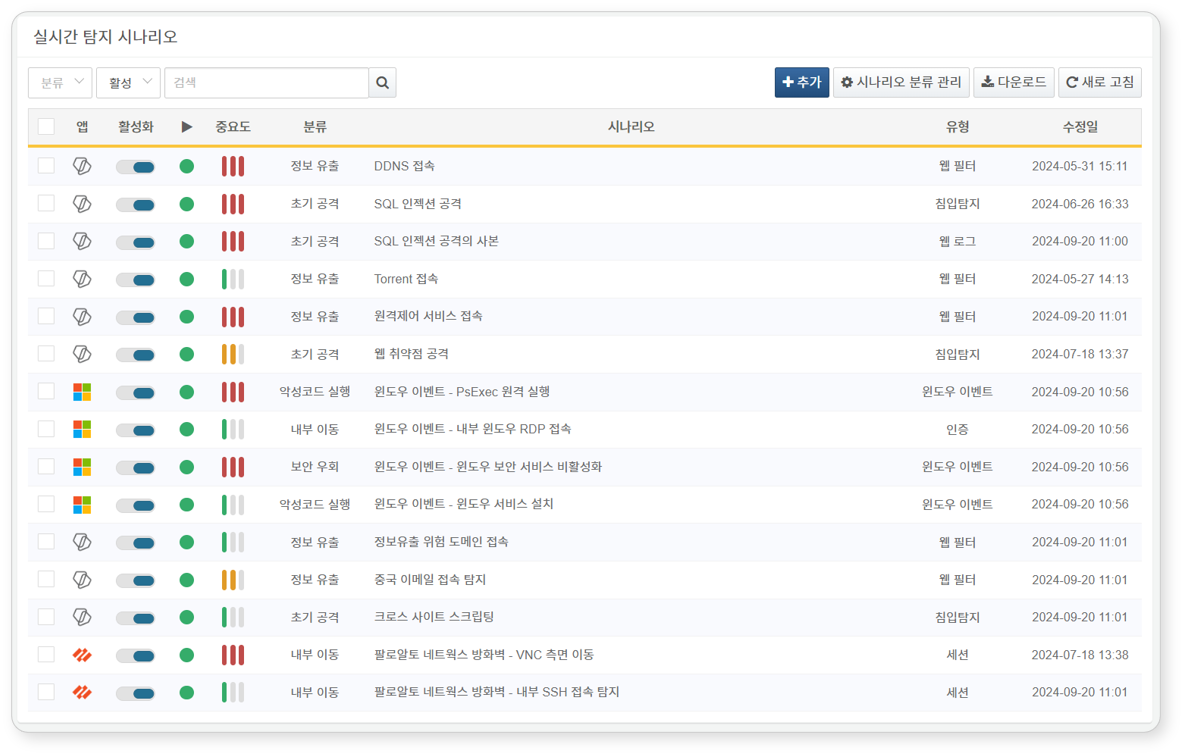
- App: Icon indicating the related app. Default rules or user-added rules are represented by Logpresso icon, and rules from installed apps are represented by their app icons.
- Enabled: Toggle button to enable/disable the rule (
 : Enabled,
  : Disabled)
 - Status: Rule status according to the Enabled setting (Green: enabled, Gray: disabled)
- Priority: Importance of the rule (high, medium, low)
- Category: Category information
- Rule: Name of the stream rule
- Type: Log schema set for the rule
- Modified At: Date the stream rule was last modified (or created)
To find a specific stream rule from the list, use the search tool in the toolbar. The search tool finds the rules where the keywords you enter are included in the rule's Name, Description, or Query fields. The search is not case-sensitive.
Enable and Disable Stream Rule
To enable or disable a stream rule, click the toggle button in the Enabled column of the rule (: Enabled, : Disabled).
Download Stream Rule List
To save the list of stream rules to your local PC, click Download in the toolbar and select the desired file format to download.
Refresh Stream Rule List
To view an up-to-date list of stream rules, click Refresh in the toolbar.
Add Stream Rule
To add a stream rule:
-
Go to Policies > Stream Rules and click Add in the toolbar.
-
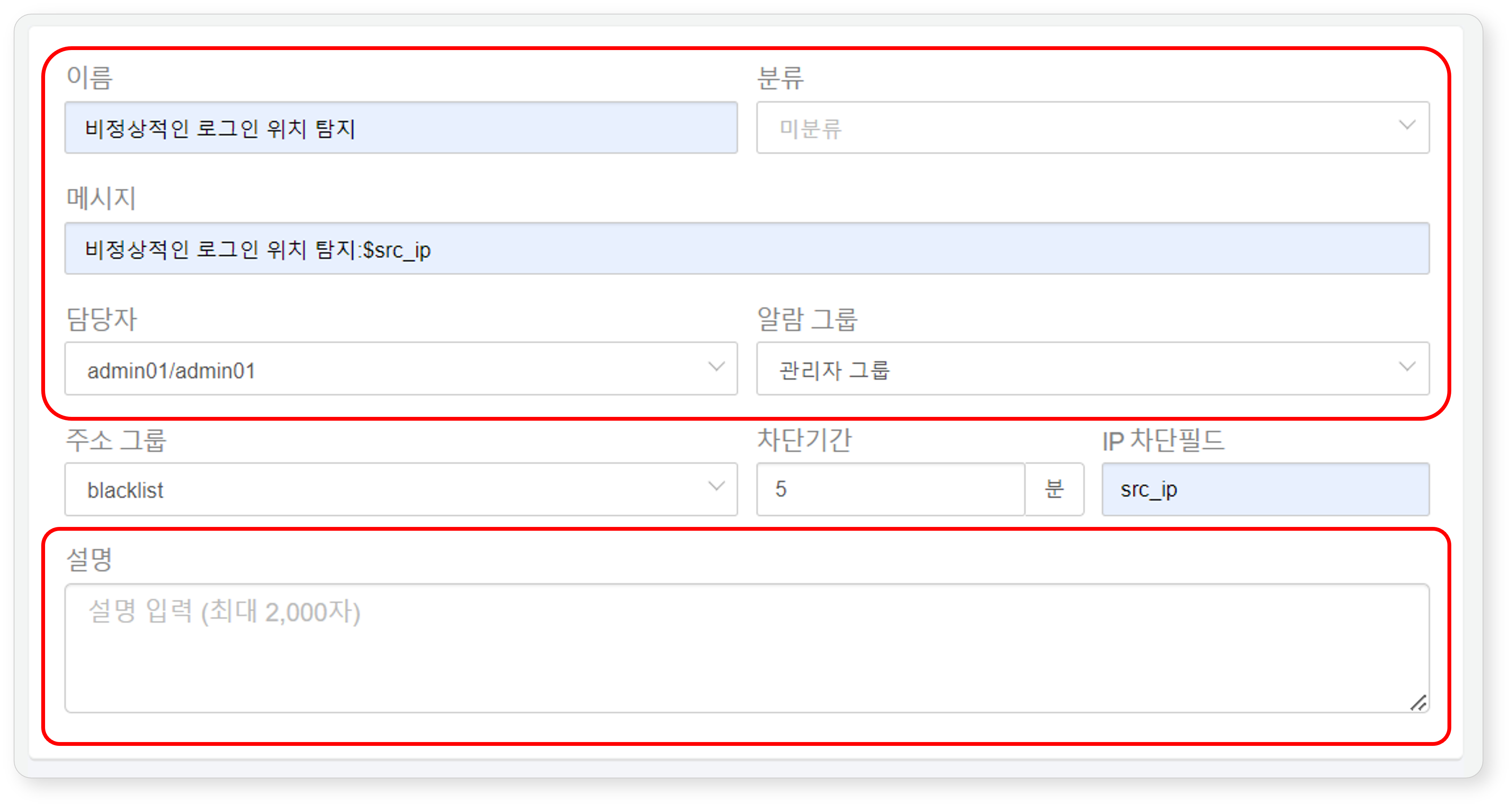
On the Add Stream Rule screen, enter the following basic settings:
-
Name: Unique name for the stream rule (up to 255 characters). Rule names cannot be duplicate.
-
Category: Stream rule category. You can add a rule category by clicking Categories in the toolbar. If no category is set, no ticket will be issued.
-
Message: Title assigned to the ticket upon event detection
- Use field names defined in the log schemas in the format
$fieldor$field$, the message is generated by fetching the field value from the log that was the basis for the event detection (e.g.,$src_ip). For fields containing Korean characters, always use the$FieldName$format. - If Detect Duplicates on option is not specified in Advanced settings, it will prevent duplicate tickets from occurring based on whether the generated message (up to 2,000 characters) is identical or not.
- Use field names defined in the log schemas in the format
-
Assign to: User account to assign the issued ticket to. You can select more than one account. If unspecified, the ticket is created without an assignee.
-
Alarm Group: Alarm group to receive alarms when an event is detected.
NoteAlarm reception settings must be configured within the selected Alarm Group.
-
MITRE ATT&CK technique: MITRE ATT&CK technique associated with the detection scenario. Search for a technique in the search box and select it to add it as a tag. Click the close (×) icon on a tag to remove it.
-
MITRE ATT&CK tactic: MITRE ATT&CK tactic associated with the detection scenario
- When you select at least one MITRE ATT&CK technique, the tactic search box is disabled, and tactics automatically derived from the selected techniques are displayed as tags. Click a tactic tag to toggle it between included and excluded; at least one tactic must remain included.
- When no MITRE ATT&CK technique is selected, you can search for and add tactics directly in the search box, or click the close (×) icon on a tag to remove it.
-
Description: Detailed description of the stream rule (up to 2,000 characters).
-
-
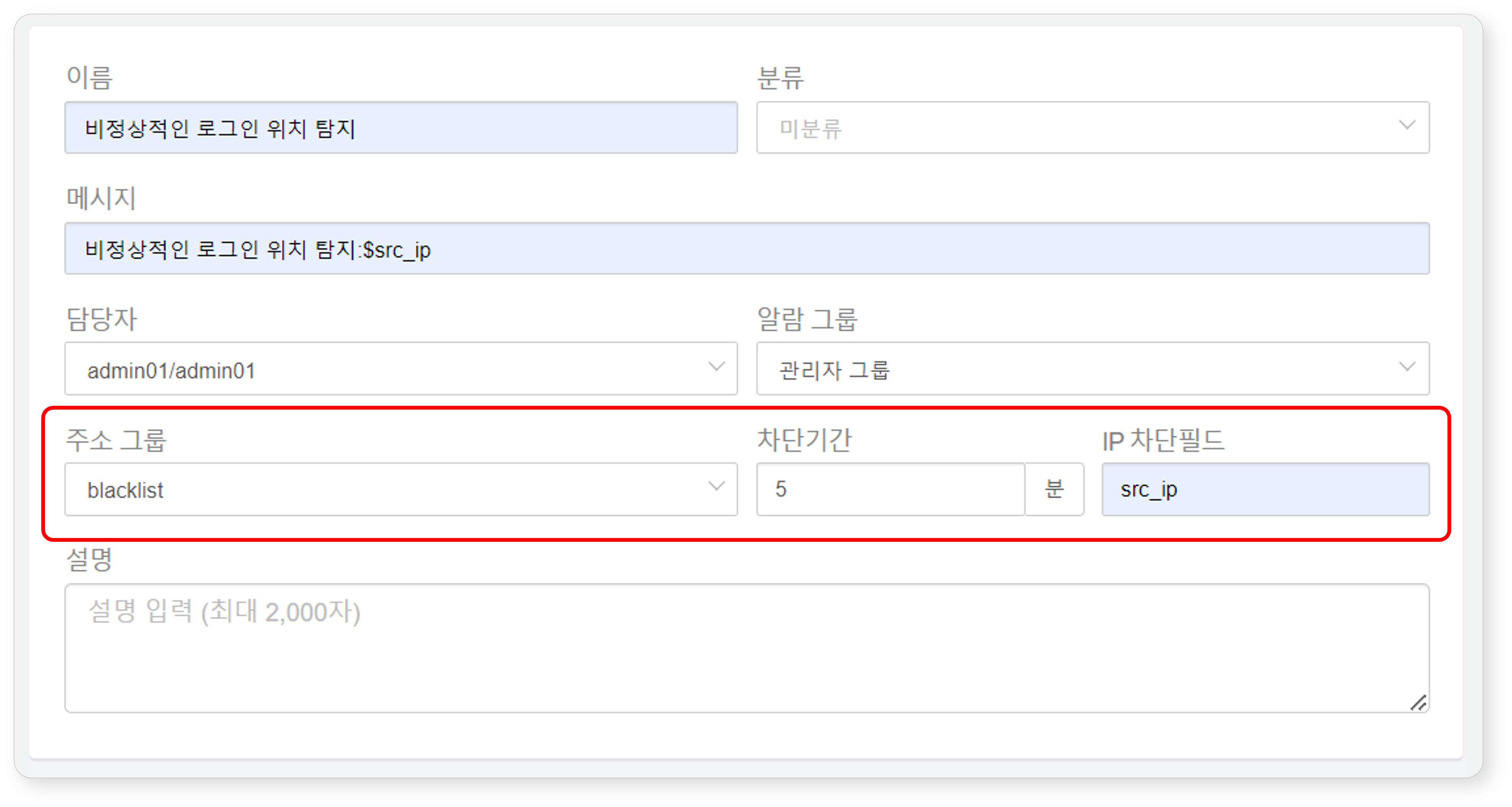
To separately manage the attacker's IP address or abnormal actor's IP address, or to forward address group information to firewalls or IPSs, configure the following settings:
-
Address Group: Address group to which the value (IP address) of the field specified as IP Field is added.
-
Retention: Duration (in minutes) to retain the IP address in the address group. Once the specified blocking period expires, the IP address is automatically removed from the address group. If unspecified, the IP address remains permanently (range: 1–100,000,000).
-
IP Field: Field name containing the IP address to be added to the address group upon event detection. Enter the name of the IP-related field defined in the log schema (e.g.,
src_ip,dst_ip) (up to 50 characters).NoteFor integration with third-party security systems for blocking actions, refer to 'System > Response Targets.'
-
-
Configure the priority of detected events for the logger (or logger model):
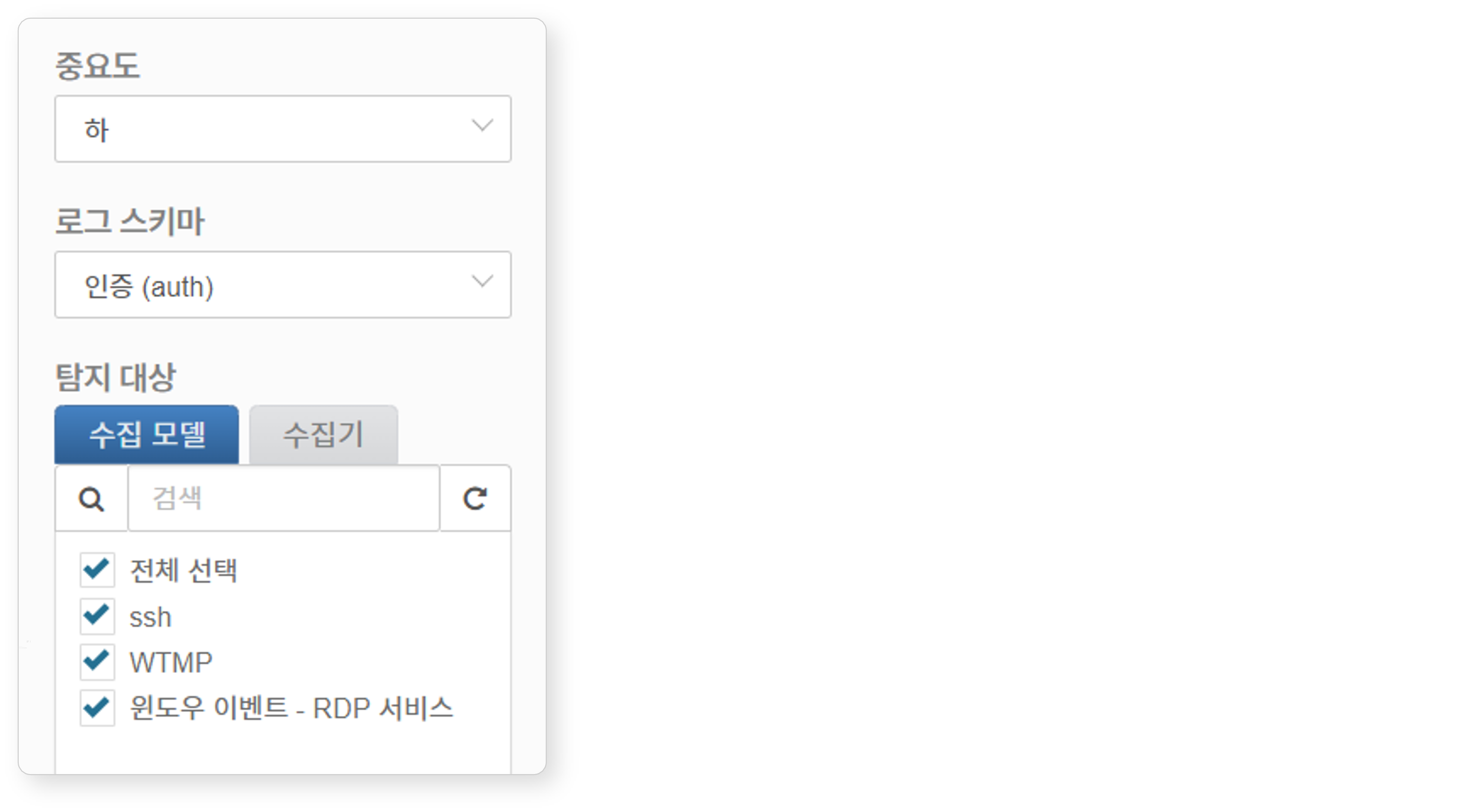
- Priority: Severity of detected events (high, medium, low).
- Normalization Schema: Log schema to apply to the stream rule. Available fields in the Scenario Builder depend on the selected log schema.
- Target: Logger model (or logger) to apply to the stream rule. Only logger models and loggers associated with the selected log schema are displayed.
NoteIf the Logger Model has only "Raw" normalization rules without referencing a Log Schema, it will not appear in the detection target list. Ensure that the logger model references a log schema.
-
Create the threat detection scenario. Use the Scenario Builder or directly enter a query in Query field to define the detection scenario. For detailed information about the Scenario Builder, refer to Rules and Parameters by Field Type.
A scenario consists of at least one rule, applied in the order listed at the top of the scenario list. When data is collected through the selected target, it is matched against the rules in order. A preceding scenario must be satisfied before the next scenario is executed. The order of scenario execution can impact system performance; therefore, it is recommended to set simple and fast conditions first to filter unrelated logs early.
If you enter an invalid or non-executable query (e.g., referencing a nonexistent address groups or pattern groups) the detection rule cannot be added.
- Scenario Builder: A detection scenario editor comprising Condition, Field, and Rule. After enter a scenario, click Add to register it in the scenario list. At least one scenario must be registered.
- Condition: The condition for applying the scenario (
AND,NOT; default:AND). - AND:trueif it matches. - NOT:trueif it does not match. - Field: Field from the log schema to compare with the Rule
- Rule: Rule to apply to the Field. The rules are available depending on the selected Field.
- Condition: The condition for applying the scenario (
- Query: Directly input a query if you prefer to manually define filter conditions (up to 10,000 characters).
- Stream Query: Displays the filter rules entered in Scenario Builder or Query as a stream query.
-
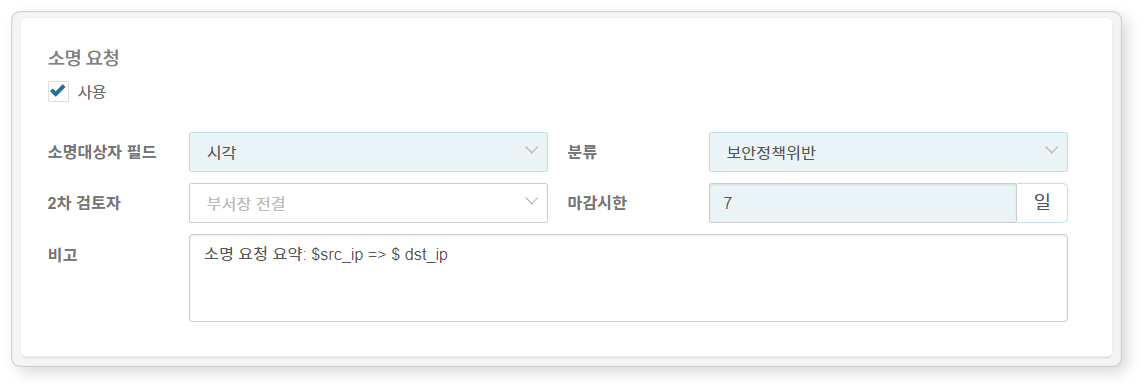
If a detected event is related to an employee within the organization, you can request an explanation from the employee.
-
Explanation Request: Whether to request an explanation from the employee or personnel involved in the detected threat or event. (default: disabled).
-
Employee: Field containing the employee ID of the employee responsible for the detected evnet.
When a threat is detected, an explanation request email is automatically sent to the employee mapped to the specified employee ID. In this case, make sure that employee information (employee ID, account, email) is configured under Policies > Employees.
-
Category: The classification of the explanation request. If necessary, additional categories can be configured under Response > Explanation > Categories.
-
Auditor: The secondary reviewer of the submitted explanation (if not set, defaults to "Department Head"). For more details about primary and secondary reviewers, refer to Explanations.
-
Due Date: The deadline for submitting an explanation (default: 7 days). After the deadline, the employee will no longer be able to submit an explanation.
-
Explanation Request Message: Additional information to include in the explanation request email. The input text will be inserted into the email/SMS template where the
$user_notemacro is located. If you insert field names defined in the log schema using the$FieldNamemacro format, the field values will be substituted in the message. You can view the Explanation Request Message in the detailed explanation view under Response > Explanations. (Up to 10,000 characters)
NoteTo request an explanation, a field named "emp_key" is required. If this field does not exist, click **Query** in Step 5 and create an "emp_key" field by writing a query that maps user accounts or IP addresses to employee IDs.
-
-
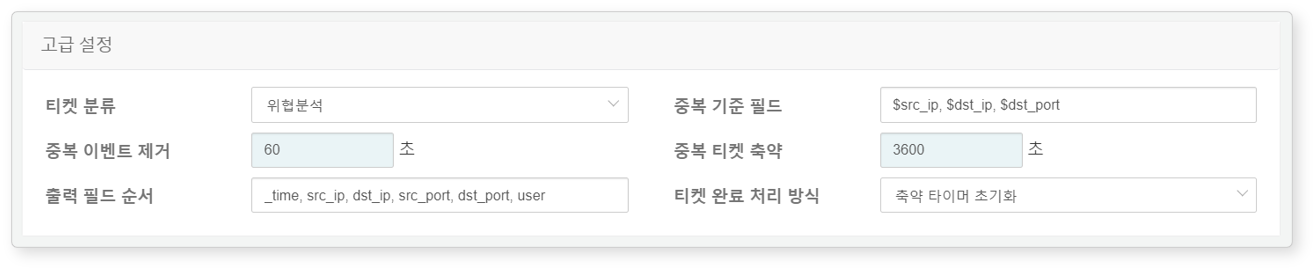
To issue a ticket upon event detection, configure the Advanced settings.
-
Ticket Category: Ticket Category required to classify tickets during security operations. (Default: None)
```note
To automatically generate a ticket upon event detection, you must specify a ticket category.
Ticket issuance can also be controlled within playbooks triggered by events. If you intend to control ticket creation within a Playbook, do not set this option here. ```
-
Detect Duplicates on: Specify fields used to detect duplicate tickets, using the macro format (e.g.,
$field_name), separated by commas (,). Maximum length is 2,000 characters. If not specified, the Message string is used as the default criterion.```note For example, if the message field is configured as "C&C Server Connection: $src_ip -> $dst_ip," but you want to prevent excessive ticket generation when the same host connects to different C&C servers, set the duplicate detection key to `$src_ip`. ``` -
Detect Duplicates for: Duration during which duplicate events are ignored after a ticket is issued. (Default: 0, Range: 0–86,400 seconds).
- If set to "0": Behavior is determined by the Reassign Tickets for setting.
- If set to a nonzero value: Duplicate events are ignored for the specified duration and are not included as supporting data in the ticket.
-
Reassign Tickets for: Duration during which new tickets are not created for recurring events; instead, supporting data and occurrence counts are added to the existing ticket. (Default: 3,600 seconds, Range: 0–86,400 seconds) - If set to "0": A new ticket with the same title is created for each event occurrence. - If set to a nonzero value: Supporting data and occurrence counts are added to the existing ticket during the specified period.
-
Field Order: The order in which log data fields appear in the ticket’s supporting data. Enter field names in the desired order, separated by commas (,). Maximum length is 2,000 characters. Special characters and pipe (|) symbols are not allowed.
-
On Closing Ticket: How to handle tickets after they are closed when Reassign Tickets for is enabled (Default: Reset Ticekt Timer). - Keep Ticket Timer: Even after a ticket is closed, if the same threat event occurs before the merge timer expires, supporting data and occurrence count are added to the closed ticket. - Reset Ticket Timer: When a ticket is closed, the merge timer is also considered expired, and a new ticket is created for subsequent identical threat events.
- Click OK to finalize adding the stream rule. The stream rule becomes active immediately after creation.
Rules and Parameters by Field Type
Scenario Builder allows you to configure rule based on field types defined in the log schema. The available rules and parameters vary depending on the data type of each field, as described below.
STRING
| Rule | Parameter | Scope | Load | Description |
|---|---|---|---|---|
| Matches target string | Target string | Maximum 255 characters | Low | Filters field values that match the Target string. |
| Contains target string | Substring | Maximum 255 characters | Low | Filters field values containing the specified substring. |
| Detects signature pattern | Target signature pattern | Signature groups | Medium | Filters field values based on a signature pattern. |
BOOL
| Rule | Parameter | Scope | Load | Description |
|---|---|---|---|---|
| True/False | Condition | 참인 경우 or 거짓인 경우 (True/False; hardcoded in Korean regardless of locale) | Low | Filters field values based on true/false conditions. |
SHORT/INT/LONG/DOUBLE
| Rule | Parameter | Scope | Load | Description |
|---|---|---|---|---|
| Equals | Target value | -9007199254740991 ~ 9007199254740991 | Low | Filters field values that match the specified value. |
| Is within the range of | Start, End | -9007199254740991 ~ 9007199254740991 | Low | Filters field values within the specified range. |
| Greater than | Target value | -9007199254740991 ~ 9007199254740991 | Low | Filters field values greater than the specified value. |
| Greater than or equals | Target value | -9007199254740991 ~ 9007199254740991 | Low | Filters field values greater than or equal to the specified value. |
| Less than | Target value | -9007199254740991 ~ 9007199254740991 | Low | Filters field values less than the specified value. |
| Less than or equals | Target value | -9007199254740991 ~ 9007199254740991 | Low | Filters field values less than or equal to the specified value. |
DATE
| Rule | Parameter | Scope | Load | Description |
|---|---|---|---|---|
| Day | Selected Days | Multi-select from Sun–Sat | Low | Filters data generated on specified days. |
| Weekend | - | - | Low | Filters data generated on weekends. |
| Weekday | - | - | Low | Filters data generated on weekdays. |
| Time range | Start Time, End Time | 0 ~ 23 hours | Low | Filters data generated during specified time range. |
COUNTRY
| Rule | Parameter | Scope | Load | Description |
|---|---|---|---|---|
| Country Code | Target country code | Select a country code. | Low | Filters field values that match the specified country code. |
PORT
| Rule | Parameter | Scope | Load | Description |
|---|---|---|---|---|
| Port number | Target port number | 0 ~ 65535 | Low | Filters field values that match the specified port. |
| Is in port group | Target port Group | Select from predefined port groups. | Low | Filters field values that belong to the specified port group. |
IP
| Rule | Parameter | Scope | Load | Description |
|---|---|---|---|---|
| Matches IP Address | Target IP | IPv4 format address | Low | Filters field values matching the specified IP address. |
| Is included in network range | Target network range | Select network range. | Low | Filters field values included in the specified network range. |
| Is included in address group | Target address group | Select address group. | Low | Filters field values included in the specified address group. |
| Is listed in specific reputation DB | Reputation DB | Select threat intelligence source. | Medium | Filters field values listed in the specified reputation database. |
| Create event context by IP Address | Event name, Timeout | Maximum 255 characters, 0~86400(mon/h/m/s) | High | Creates an event context using the IP address as the key and registers it for tracking within the specified timeout period. |
| Correlate events by IP address | Event name | Maximum 255 characters | High | Searches for events related to the IP address registered in the specified event context. |
| Exceeds event threshold | Event name, Threshold | Maximum 255 characters, threshold is between 0~9007199254740991 | High | Filters IP addresses exceeding the specified event threshold. |
| Listed in any reputation DB | - | - | Medium | Filters field values that have appeared in any threat intelligence database. |
MD5/SHA1/SHA256
| Rule | Parameter | Scope | Load | Description |
|---|---|---|---|---|
| Matches hash value | Hash | Maximum 255 characters | Low | Filters field values matching the specified hash. |
| Listed in reputation DB | - | - | Medium | Filters field values appearing in any reputation database. |
| Listed in specific reputation DB | Reputation DB | Select threat intelligence. | Medium | Filters field values listed in the specified reputation database. |
URL
| Rule | Parameter | Scope | Load | Description |
|---|---|---|---|---|
| Listed in reputation DB | - | - | Medium | Filters field values appearing in any reputation database. |
| Listed in specific reputation DB | Reputation DB | Select threat intelligence source | Medium | Filters field values listed in the specified reputation database. |
DOMAIN
| Rule | Parameter | Scope | Load | Description |
|---|---|---|---|---|
| Matches domain | Target string | Maximum 255 characters | Low | Filters field values matching the specified string. |
| Listed in reputation DB | - | - | Medium | Filters field values appearing in any reputation database. |
| Listed in specific reputation DB | Reputation DB | Select threat intelligence source. | Medium | Filters field values listed in the specified reputation database. |
Others (e.g., BLOB)
| Rule | Parameter | Scope | Load | Description |
|---|---|---|---|---|
| Behavior profile detection | Behavior profile | Select behavior profile. | Low | Filters field values matching a behavior profile key field. |
Duplicate Stream Rule
To duplicate an existing stream rule:
- In the list of stream rules, select the checkbox for the rule you want to duplicate.
- The action menu appears in the toolbar. Click Duplicate.
- In the Duplicate Stream Rule dialog, review the selected rules and click Duplicate. To cancel, click Cancel.
- The duplicated rule is added in a disabled state, named by appending a fixed suffix to the original rule name. This suffix is not localized. It is always the Korean text "의 사본" ("copy of"), even in the English console (for example, "DDNS Access의 사본"). If you duplicate the same rule repeatedly, the copies are automatically numbered to distinguish them, such as (2) or (3).
Edit Stream Rule
To edit a stream rule:
- In the list of stream rules, click the name of the stream rule you want to edit.
- In the Edit Stream Rule screen, update the information, then click OK. For descriptions of the editable properties, refer to Add Stream Rule.
The rule edit screen has Config, Version History, and Exception Conditions tabs at the top. The Config tab is the screen described above for editing the basic settings. For version history, refer to View Stream Rule Version History. For exception rules, refer to Stream Rule Exception Rules.
Delete Stream Rule
To delete a stream rule:
- In the list of stream rules, select the checkbox for the rule you want to delete.
- The action menu appears in the toolbar. Click Delete.
- In the Delete Stream Rule dialog box, review the selected rules and click Delete. To cancel, click Cancel.
Rule Categories
Rule categories are used to manage detected events based on attack types. You can define a category when adding a rule. The default categories are based on the MITRE ATT&CK matrix.
| Category | MITRE ATT&CK Tactics |
|---|---|
| Initial Access | Initial Access |
| Execution | Execution |
| Persistence | Persistence |
| Privilege Escalation | Privilege Escalation |
| Defense Evasion | Defense Evasion |
| Credential Access | Credential Access |
| Discovery | Discovery |
| Lateral Movement | Lateral Movement |
| Collection | Collection |
| C&C | Command and Control |
| Exfiltration | Exfiltration |
| Impact | Impact |
| Reconnaissance | Reconnaissance |
To add/edit/delete rule categories, go to Policies > Stream Rules or Policies > Batch Rules, then click Categories in the toolbar.
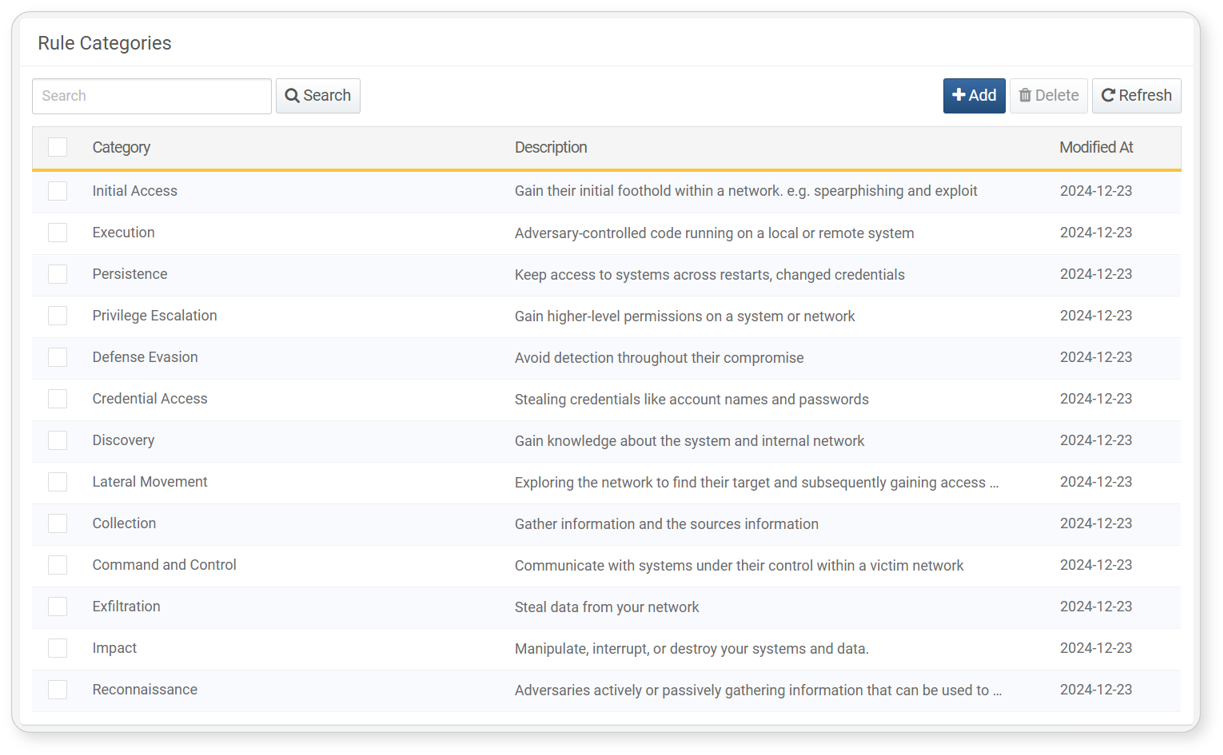
- Category: Name of the rule category
- Description: Detailed description of the rule category
- Modified At: Date and time the category was last modified
The list is displayed in ascending order by category name, with 15 items shown per page.
Download Rule Category List
To download the rule category list:
-
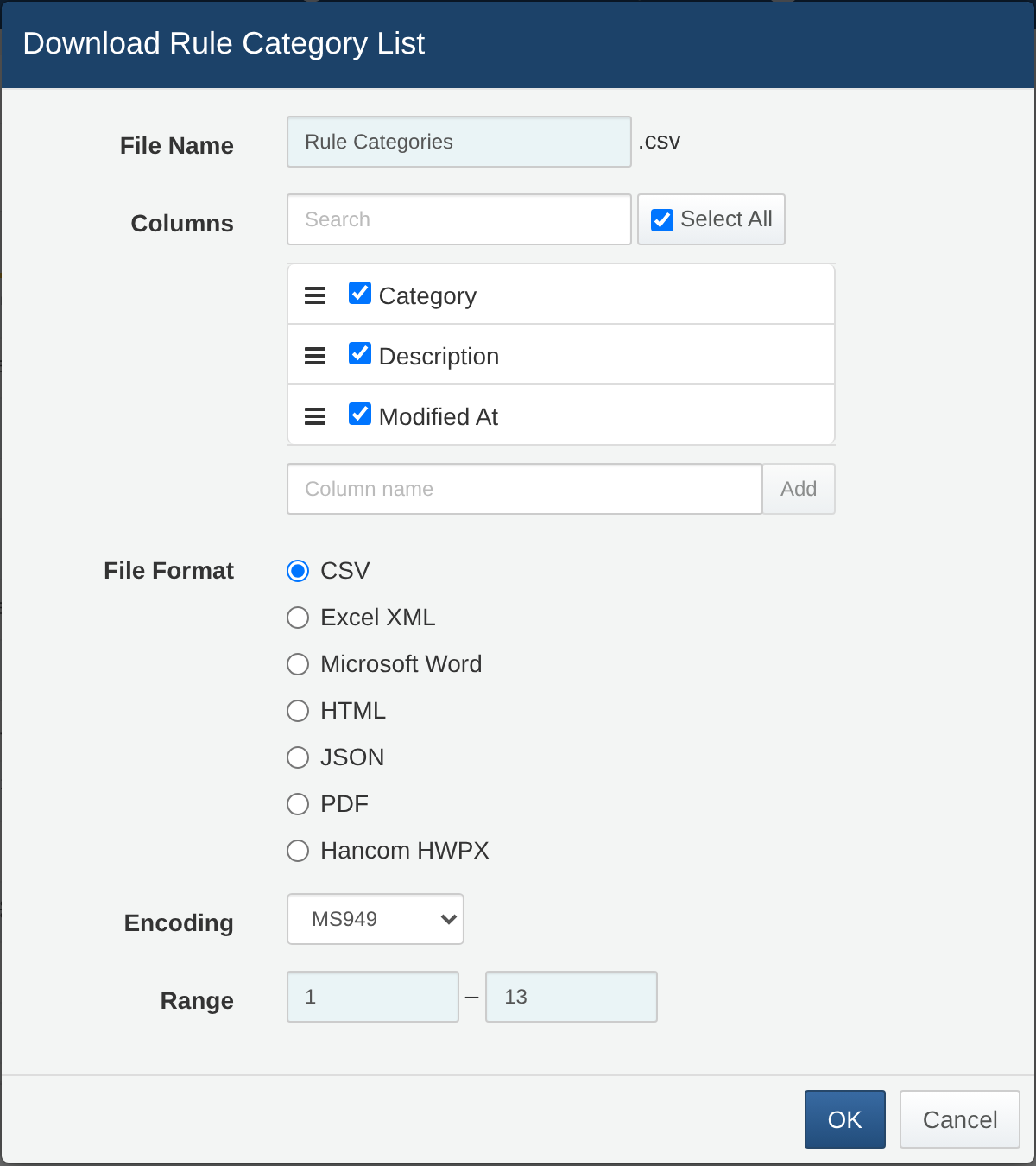
In the Rule Categories window, click Download in the toolbar. If the list is empty, the Download button is disabled.

-
In the Download Rule Category List dialog box, specify the File Name, Columns, File Format, Encoding, and Range, then click OK. The default file name is "Rule Categories", and the available columns are Category, Description, and Modified At.
Add Rule Category
To add a rule category:
-
In the Rule Categories window, click Add.
-
In the New Rule Category page, enter the category details and click OK.
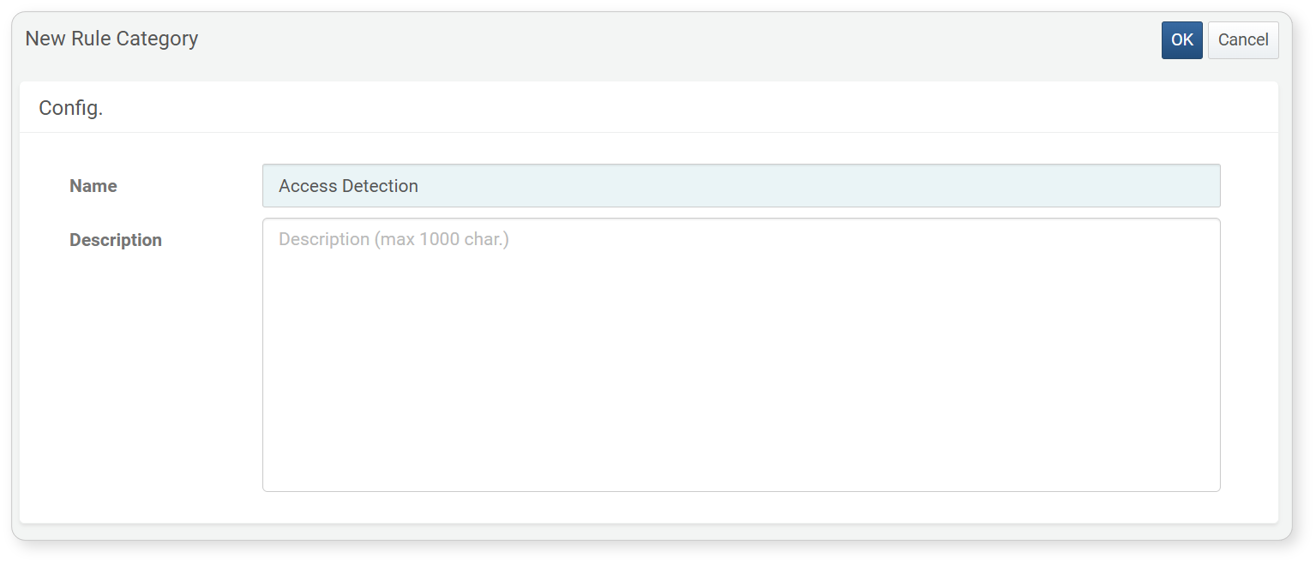
- Name: Unique name of the rule category (up to 50 characters)
- Description: Detailed description of the rule category (up to 1,000 characters)
Edit Rule Category
To edit a rule category:
- In the Rule Categories window, click the name of the category you want to edit.
- In the Edit Rule Category page, update the details and click OK.
Delete Rule Category
To delete a rule category:
- In the Rule Categories window, select the checkbox for the category you want to delete.
- In the toolbar, click Delete.
- In the Delete Rule Category dialog box, review the selected categories and click Delete. To cancel, click Cancel.
View Stream Rule Version History
A new version is automatically created every time you add or edit a stream rule. On the Version History tab of the rule edit screen, you can review past versions, restore a specific version, or duplicate it as a separate rule. The Version History tab is displayed only to accounts with rule edit permission.
- In the list of stream rules, click the name of the rule whose version history you want to check.
- Click the Version History tab at the top of the rule edit screen. Version cards are displayed in reverse chronological order, starting with the most recent version.
Each version card displays the following information:
- The time the version was changed, the account that changed it, and the version number (for example,
Changed by csp at 2026-05-14 15:36:48. - Version 22) - A comparison of the query with the previous version (a line-by-line diff with line numbers, shown with
-for deletions and+for additions). This is not shown for a version in which the query did not change. - Change History: Shows the items that changed compared to the previous version, in the format
item is changed to new value. (previous: previous value). If more than 3 items changed, only the first 3 are shown; click Show More (N more items) (where N is the number of remaining items) to view all of them, and Show Less to collapse them again. If no items changed,No changes to show.is displayed. - If the version was created by a restore, the version number it was restored from (for example,
Restored to version 5.)
Restore a Previous Version
To roll back a rule to the settings of a previous version:
- On the Version History tab, find the version card you want to restore. The Restore button is not displayed for the version currently in use or for a version with no changes.
- Click Restore on the card.
- In the Restore Scenario dialog box, review the version to restore and click OK. To cancel, click Cancel.
- If the restore succeeds, the restored settings are created as a new version, and you are returned to the Config tab. If the version being restored references a log schema, logger, address group, or similar item that has already been deleted and can't be restored, a dialog box showing the failure reason is displayed. Clicking Edit Scenario in that dialog box fills in the Config tab with the settings, leaving only the fields that could not be restored blank. Enter the missing values and save to register the changes as a new version.
Duplicate a Previous Version as a New Rule
To create a separate rule based on the settings of a previous version:
- On the Version History tab, click Duplicate on the version card you want to duplicate. The Duplicate button is also not displayed for a version with no changes.
- In the Clone Scenario dialog box, enter a name for the new rule and click OK. The default name is "Clone of rule name Version N".
- The new rule is added under the entered name.
Stream Rule Exception Rules
Repeatedly occurring events that are operationally acceptable create unnecessary work if a ticket is issued every time. Exception rules let you exclude events that match a condition from ticket creation, even when they are otherwise detected. The Exception Conditions tab is displayed to accounts with view permission as well, but only accounts with edit permission can add or delete rules.
- In the list of stream rules, click the name of the rule for which you want to configure exception rules.
- Click the Exception Conditions tab at the top of the rule edit screen.
The list displays the following information:
- Rule: The configured exception condition (in JSON format)
- Memo: A description of the exception rule
- Validity Period: The start and end date/time during which the exception rule applies
- Author: The account that added the exception rule
To find a specific rule in the exception rule list, use the search tool in the toolbar.
Refresh List
To view the exception rule list with the latest information, click Refresh in the toolbar.
Add Exception Rule
To add an exception rule:
-
On the Exception Conditions tab, click Add in the toolbar.
-
On the Set Exception Condition screen, configure the items and click Add.
- Type: How the exception condition is composed (default: Source IP; options: Source IP, Destination IP, Source IP / Destination IP, Custom)
- If you select Source IP, Destination IP, or Source IP / Destination IP, a simplified input row is displayed for the
src_ipordst_ipfield, where you only need to enter an operator and a comparison value. The comparison value can only be a single IP address; CIDR notation is not supported. - If you select Custom, a condition builder is displayed where you can compose conditions directly.
- You can set a condition group to AND or OR, and nest condition groups inside a group (up to 3 levels).
- You can add up to 50 conditions (including nested conditions) in total, and up to 10 condition groups.
- Field: Select a Sonar event standard field using auto-complete, or manually enter a field name (up to 128 characters) made up of letters, digits, periods (
.), underscores (_), and hyphens (-). - Operator: The available operators depend on the field type and on whether the field is a standard field.
- String: Most standard fields provide only Equal, Not equal, Is null, and Not null (the
urlfield is an exception and also provides Starts with and Ends with). A field that is not in the list of standard fields can use all of Equal, Not equal, Starts with, Ends with, Contains, Is null, and Not null. - Number: Equal, Not equal, More than, At least, Less than, At most, Is null, Not null
- Boolean/IP: Equal, Not equal, Is null, Not null
- String: Most standard fields provide only Equal, Not equal, Is null, and Not null (the
- Value: The value to compare (if the field type is boolean, choose TRUE or FALSE; if the field type is IP, enter a single IP address without CIDR notation; not required if the operator is Is null or Not null)
- If you select Source IP, Destination IP, or Source IP / Destination IP, a simplified input row is displayed for the
- Memo: A description of the exception rule (up to 2,000 characters)
- Validity Period: The start and end date/time during which the exception rule applies (both required; the start date/time cannot be later than the end date/time). When you open the screen, the period defaults to today through 7 days from today.
- Type: How the exception condition is composed (default: Source IP; options: Source IP, Destination IP, Source IP / Destination IP, Custom)
Delete Exception Rule
To delete an exception rule:
- In the exception rule list, select the checkbox of the row for the rule you want to delete.
- Click Delete in the toolbar.
- In the Delete Exception Condition dialog box, review the list of exception rules to delete and click Delete. To cancel, click Cancel.
Delete Expired Exception Rules
To clear expired exception rules at once:
- On the Exception Conditions tab, click Delete expired rules in the toolbar.
- Review the list of expired exception rules shown in the dialog box and click Delete. If there are no expired rules, the list is displayed empty.